Building The Net Torque Model – Part 3

Appending The Conservative Models

After investigating the causal relationship between torque and angular acceleration, I introduced the possibility to the class that perhaps we also needed to revisit the Energy Transfer Model and the Momentum Transfer Model. The students agreed that an object that is rotating must have energy. This was pretty easy to demonstrate.

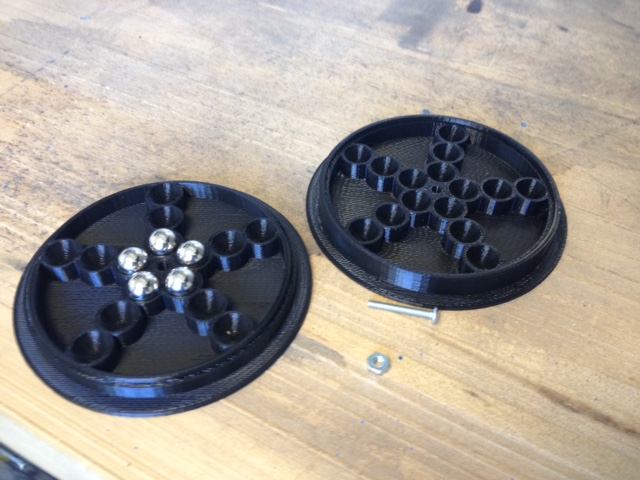
I set up a situation in the class where two of the variable inertia disks that we created on the 3D printers were placed at the top of an inclined ramp. The internal marbles were placed at two different configurations inside the disks and then the students predicted which disk would reach the end of the ramp first. I was pleased to find out that the class appeared to agree that the disk with the marbles located closer to the radius would be the winner. I really think that our investigation with the variable inertia disks solidified the students’ conceptual understanding of rotational inertia and the importance of mass distribution.

I have not yet found a good experiment where students could discover the rotational kinetic energy relationship, so I decided to take them through a derivation based on linear kinetic energy. I then asked the students to do some whiteboard work. I asked them to demonstrate that the disks would indeed reach the end of the ramp at different times. Although this wasn’t strictly a constructivist approach, it was good practice in doing some fairly difficult algebra without numerical values – something the students traditionally are not very good at.

We then moved onto momentum. Again, I started by reviewing the Momentum Transfer Model for a particle. At this point the pattern had been fairly well established. The relationship between angular and linear quantities seemed to have taken hold because the students were quick to propose a mathematical definition for angular momentum. Our next goal was to figure out whether this was a conserved quantity.

Mr Holt and I had created a set of metal disks that could be attached to the rotary sensors. I decided to create our own, rather than (sorry Vernier) buy them as I thought that the commercial kit was over priced. It wasn’t too hard to create the disks, especially when you have access to a CNC plasma cutter!

image1

The students attached one disk to the rotary motion sensor and then got that disk spinning. They then took a second disk that had small magnets attached to it, and dropped this disk onto the spinning disk. The students compared the angular velocity before and after the disks were combined and then calculated the angular momentum of the system before and after. The data we got was quite good with the class getting in the range of only about a 5% to 6% difference.

Wrapping it Up (or Un-Rolling It Down)

As a final deployment, I decided to try the deployment activity that Frank Nochese did with his students. It seemed like a good (and fun) way to wrap up our model (or as I have already argued – models).

Before doing the deployment activity, I reviewed all the model specifics with the students. My point here was to impress on them that what we had not really built a new model, but rather had extended many of the prior particle models to include rigid extended bodies. This generally only required that we consider the moment arm in all the particle models. I think this really helped a number of students see the connection between models that they felt they understood and all this rotational stuff that seemed a bit confusing.

I then set them up with the deployment activity, but I asked them to specifically solve the problem using both energy and net torque. There was some success, but I realized that the task was a bit much for the class. Once again, it is clear that I need to give them more practice with these problems that require multiple steps and that involve algebraic manipulation of symbols without numbers. Plenty of time to practice that!
Building The Net Force Particle Model (Part 1)

From “The How” to “The Why”:

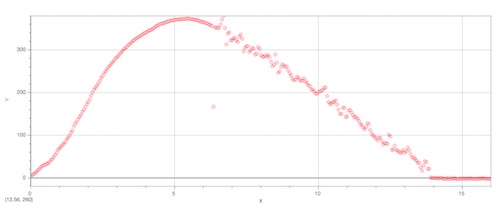
One of the three projects that the students will complete this year is a custom designed and fabricated rocket. One of the requirements of this project is for the rockets to carry a small solid state altimeter that collects vertical position data. This year I decided to give the students some data collected by last year’s students. Here is what the data looks like from one typical altimeter reading:

Rocketdata2013

As an introduction to this next model, I presented them with the data and asked them to use both the Constant Velocity Particle Model and the Constant Acceleration Particle Model to describe the motion of the rocket based on the data. Students responded to several questions that I created and they posted their answers through the Learning Management System we use.

A Simple Definition, A Simple Representation

The student investigation teams were then asked to draw velocity vs time graphs on their whiteboards. I was impressed to see that most teams were able to interpret the position data and create a velocity graph that agreed with the data. There was some debate about the graphs, but the students worked through these differences and came to consensus around what the graph would most likely look like. At this point I was thinking about using LoggerPro’s ability to graph the derivative of a data set, but decided that I would leave that for a later date, though next year I might do it earlier.

I then introduced a very basic definition of a force:

“A Force is A Push or A Pull”

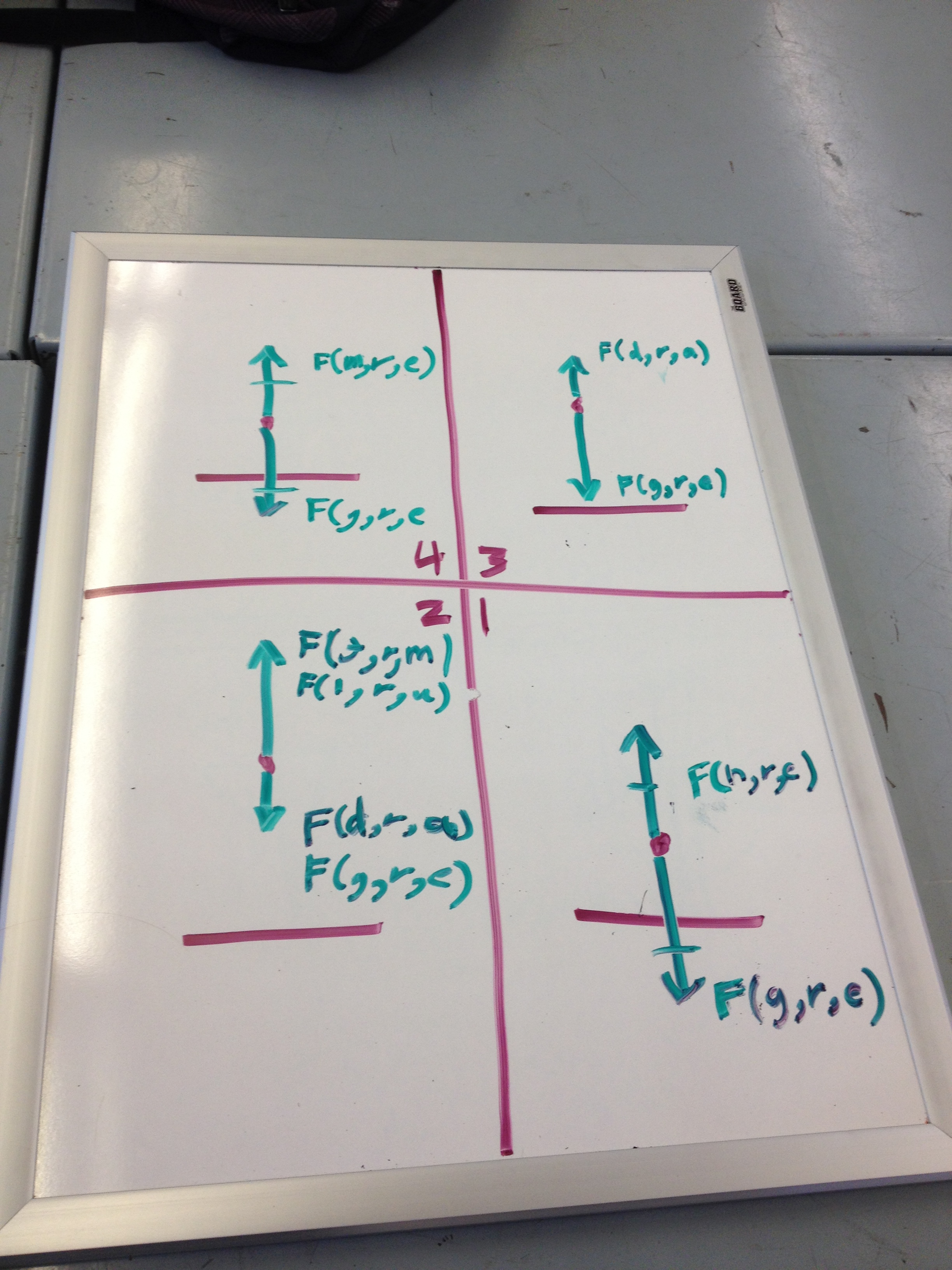
And then I proposed that we could represent the force with an arrow, just as we had done with velocity and acceleration. I then asked them to divide the rocket data into four sections based on the answers to the questions we had discussed. The students then drew a representation of the rocket in each stage and the forces acting on the rocket. The stages the students identified were 4) on the ground, 3) descending by parachute, 2) going up without fuel, and 1) going up with fuel. I asked them to draw the diagrams by starting at the end. Here is a typical example of the force diagrams the students drew:

photo 2

The labeling is a standard that is outlined in the Modeling methodology – it reads (type, feeler, dealer).

Constant Velocity Motion and Net Force

We started the class discussion by looking at the forces acting on the rocket when the rocket was on the ground. Students agreed unanimously that there were two forces acting on the rocket – one down, one up – the gravitational force and then the force from the ground. Great. Then on to the descent phase. Certainly less unanimity here. The students again agreed on the number of forces – two – one up from air resistance, one down from gravity. The students quickly got into several back-and-forth arguments about the length of the force vectors. The class was split. Were the forces equal? Or, was gravity “winning”? The big stumbling block was around the question, “if gravity was equal to the air resistance force, then why was the rocket still falling”? A classic example of Aristotelian thinking. I encouraged them to ask the question – “if gravity was winning, why wasn’t the rocket speeding up?” One student proposed that maybe the force of gravity was just ever so slightly larger. Some students pounced in this. They argued that the forces weren’t equal at first, but as the rocket (with parachute) descended, the air resistance force strengthened and eventually became as strong as the gravitational force. the reason the rocket didn’t slow down was because it was already moving when the forces became equal. Awesome. Then a student gave an excellent description of a thought experiment where a box was traveling through space in one direction and convinced the students that the box would not slow down if you pushed equally on both sides of the box. Students reached consensus – the rocket moved at a constant velocity because the forces were equal.

The “Residue” Misconception

We then progressed to the next stage. Things got really interesting. Without exception, ALL the student groups identified an arrow pointing upward, even though they all agreed that the fuel had run out. The question that I think cuts through this the quickest is to ask “who is pushing on the rocket upward?” Most students get that funny look on their faces as their brains begin to realize that they just ran into a logical conundrum. Some students start to respond – “the rocket pushes the rocket.” OK, how? What kind of force is it? A contact force? How does it push or pull itself? The students at this point began to question each other and the room erupted in arguments. Being a bit of a control freak, I’ve had to learn to allow space and time for these chaotic moments, but also realize the importance of catching the class before it descends into something less productive.

At this point, one group erased the upward force. I asked them why they had done this. They responded that they didn’t think a force was needed for the rocket to continue upward, and that gravity and air resistance were slowing the rocket down. This seemed impossible to some of the students. They asked – “but something is left over after the fuel runs out, isn’t there?” The class began to divide up into those that now believed the rocket no longer had any upward force acting on it and those that believed there was some kind of “left-over” force, what I call a “residue”. So, once again, I asked them to identify the dealer of the residue force. The answer is generally – “the fuel”. Ah, but hasn’t the fuel run out? Yes, but the rocket has gained something from the fuel and now that is what is pushing it upward.

This is not such a wild idea, and in fact is not that far from the idea of Kinetic Energy. The students that were in the “no upward force” camp started to explain to the other students in the class that the fuel had “given” the rocket its upward velocity, but now that the fuel was gone, the rocket was now slowing down. We discussed the idea that anything that was slowing down must be experiencing a force pushing in the opposite direction of its velocity. We returned to the thought experiment with the box floating through space. The students debated about whether this box would slow down if the force that had gotten the box moving in the first place disappeared. The students agreed that if there were no forces acting on it to slow it, then it was reasonable to say that it would never slow down. Students then agreed the rocket was no different. It didn’t need a force to continue moving at a constant velocity, but that if it was instead accelerating (in this case in the negative direction) then it would need a force, which was provided by gravity and the air resistance force.  The students began to coalesce around the idea that if a force was a push or a pull, then the rocket that had run out of fuel was not getting pushed any longer, and that although it was moving upward it was indeed accelerating downward.

Making Some Observations

During the next class, I had the students set up a motion detector on one side of a Vernier dynamics track and use a force meter to pull on a low friction cart. They were to also record the velocity of the cart while the students pulled twice in quick succession on a string connected to the cart and force meter.

IMG_0686

The students then shared their graphs with the rest of the class:

IMG_0687

This experiment is meant to re-enforce some of the arguments made during the previous class. The students quickly see that the velocity is measured to change when the force is applied and that the velocity is “constantish” when no force is applied. The students were ready to tackle how the force and acceleration were quantitatively related, but that’s for another post…

Deploying The Constant Acceleration Particle Model (CAPM)

The APT 1 students just recently finished building and testing (deploying) the Constant Acceleration Particle Model. As stated in an earlier post on studying velocity vs. time graphs for a constantly accelerating particle, the students used these graphs to study how the velocity changed, but also how the graph gave the students a way to calculate the change in position of the particle.

Position vs Time Graphs and “Fitting The Function”

Using the Vernier Motion Sensors, the students then collected position data for a cart that was accelerated across the table at a constant rate (using a modified Atwood’s machine setup). This revealed what some of the students had expected – the graphs were curved!

At this point, I could have introduced the process of linearizing data as some other Modelers have done, and perhaps I will do that next year, but this year I went ahead and just asked the student to use the “function fit” tool in LoggerPro. This tool fits a mathematical model to the data, and then displays that model on the screen. I can see why some teachers feel that it is better to get the students to go through the process of linearizing the data because depending on the tool in LoggerPro can lead to some misunderstanding and it encourages the students to depend on the computer to “give them the right answer”.

What Do “A”, “B” and “C” Mean?

The reason I do introduce this tool is because we are going to use it in the future, and it gives me a reason to talk about the coefficients of the fitted function. So, immediately after the students see the fitted function, I direct them to desmos.com to have some fun with quadratic functions – and (re)learn how the coefficients in the quadratic function change the curvature of the graph and the location of the vertex. This allows us to get into a good discussion about how these coefficients are related to physical changes. I ask the students to consider the questions – “How would the graph have changed if the cart had a greater acceleration?” and “What if the cart had accelerated in the opposite direction?” and “What if the cart had started from a different location?”

Cart Jousting

Once they have a solid grasp of this function, and how it can be used to predict the position of an accelerating particle, I set them off on a deployment task – cart jousting!

The students set up two carts a distance of about a meter away from each other. Each cart was on its own track. Once again, a weight hanging on string that passed over a low friction, low mass pulley was connected to each cart. I gave the students different masses for each cart so that the carts would accelerate towards one another at different rates. The students were also asked to attach a pencil to the front of the cart so that the cart would visibly push the other cart as it passed. The students used LoggerPro one more time to get the slope of the velocity vs time graph so that they had the acceleration of each cart. Using the function that outputs the position of an accelerating particle, given a specific time value, the students were able to predict the point of collision.

When I have the students do this, as suggested by modeling pedagogy, it is really important to have the students explain the process by which they established their prediction. This is done on whiteboards. I don’t however have a class discussion unless I think it is going to help certain groups. Otherwise, I take on the role of Socratic inquisitor and allow the teams that are confident, to proceed with the experiment. This allows me to coach certain teams that I know might just otherwise wait to see what other teams have done, and simply follow them.

Students then have fun taking video and sharing the video to me. I’d like to set up some way for the students to post to a social media site, but I am a bit concerned that I would need to be the filter – something I have not yet found.

Well, now its time for us to turn our attention from strictly kinematic models to causal models that describe and represent causal relationships for answering the question – “why do things move the way they do?”

Building The Net Torque Model – Part 2

Investigating An Unbalanced Net Torque

We started by looking at the fact that a disk experiencing a net unbalanced torque also experienced a change in rotational or angular velocity. The students used a rotary motion sensor to measure the angular position and the angular velocity of a disk experiencing a constant torque and the students immediately recognized the similarity between a particle experiencing constant linear acceleration and a rigid body experiencing constant angular acceleration.

IMG_0704

So, the natural next step in our investigation was to determine the causal relationship between a net unbalanced torque and the angular motion state of a rigid body. The students discussed how we might set up an investigation that would help us understand this relationship, and I helped guide them towards a final investigation design where we used a rotary motion sensor attached to the wooden disk we had used in a previous investigation.

The rotary sensors from Vernier are rather expensive, but also quite nice. They come with a plastic spindle with three different pulley radii. The only issue that I have with these is that they do not include a useful screw for attaching objects to the pulley – they expect you to purchase their completely over priced accessory kit. I don’t suggest this. Instead, you can create your own and then use a 6/32 screw to attach them to the pulley – just be careful not strip the threads!

IMG_0703

Working off a similar investigation when studying the causal relationship between a net unbalanced force and linear acceleration, the students recognized that we needed to include a force sensor for measuring the applied force. The students then had LoggerPro plot the points for the calculated torque (using a calculated column) and the measured angular acceleration.  The data isn’t super clean, but its good enough for the students to conclude that the relationship is most likely linear.

Dimensional Analysis – Inferring Rotational Inertia

I was amazed to discover that some students in the class set off to understand what the units of the slope could be reduced to. They immediately saw that the proportional constant (slope) included kg (mass) but that wasn’t all. After some work, the class had determined that the units for the slope were kg * m^2.

This led to a qualitative discussion about the inertia of rotating objects. We discussed hoops and disks primarily, and the class seemed to agree that the units made sense. Although I didn’t have any hoop-disk sets like the ones you can buy from various vendors, we did perform some thought experiments around mass distribution and rotation, but we needed to be sure that we were on the right track.

A Better Variable Inertia Disk

So last year I was looking for an investigation that would really help the students discover the importance of mass distribution for a rotating object. Reading the material on the AMTA website regarding the unit on rotational motion, the researches stressed the importance of connecting mass distribution to the rotational inertia. I found this variable inertia disk from Fischer Scientific and decided to purchase it. I commend these guys on making this, but frankly I decided that I could make a better one.

My colleague and I set about redesigning these disks. The improvements we made included a) better compartments for the metal marbles so that they didn’t move around, b) an index and lip so that the two sides fit more securely together, and c) more compartments so that we can test more mass configurations. After we made our designs, we used our Makerbot 3D printer to print out ten copies of the disks.

IMG_0707 IMG_0708

With these disks attached to the rotary motion sensors, the students were able to confirm that although the total mass of the disk did not change, the angular acceleration declined as the mass was moved outward from the radius of rotation. This was more of a qualitative investigation, but I think the students were able to clearly see how moving the mass farther from the axis affected the rotational inertia of the disk.

Deploying The Model (So far)

Now that the students had built a predictive model that described the quantitative relationship between rotational inertia, angular acceleration and net torque, they were ready to test it.

We returned to the investigation setup with the disk, but this time attached a hanging mass to the string and they attempted to predict the angular acceleration. The students immediately made the mistake (as I thought they might) in considering only the disk in the system. This gave me a chance to review with them the following process:

  1. Identify the system schema (now it includes things that can rotate!)
  2. Draw your force vector (free body/particle) diagrams and now also your force-moment arm (rigid body) diagrams.
  3. Write the summation of forces AND the summation of torques for the system.
  4. Do some algebra.

The trickiest part to figuring this out is getting the signs right due to interaction pairs and making sure that they agree. I ask the students to start with a diagram and then go through and label each force + or – by picking a force and then finding its partner and then making sure that the rest of the force directions agree.

Once they were able to get a prediction that we all agreed seemed correct, they ran the experiment. The class was able to predict the angular acceleration within about 10% error. We discussed the possible reason for discrepancy which led to some interesting discussions around modeling the rotational inertia of the attachment screw and washer, and also the frictional forces at work.

The students were pretty convinced that the model worked, and so next stop – energy and momentum in systems with rotational motion.

Building The Net Torque Model – Part 1

A New Model (or Five New Models!)

So, since I decided to incorporate AP Physics into the Academy as the singular curricular pathway for all students, I needed to see what models might need to be added (and mostly removed) from the past curriculum. The big change was to remove the study of thermodynamics and much of magnetism, and add rotation. I hadn’t officially taught rotation since the Academy was first started nine years ago and since I had started using the modeling approach, so I looked at the curriculum AMTA had stored away in its repository. After reading through the material, I honestly have to say I don’t think the American Modeling Teachers Association’s curricular material on the topic of rotational motion is as good as some of the other material they offer. First of all, I have struggled with the idea of teaching this as a unit on Rotational Motion. It seems to go against the modeling approach of defining a distinct model that is either descriptive (kinematic), causal (force), or “conservational” (energy and momentum). The material seemed too similar to the traditional approach. Also, there seems to be some major holes in the curriculum (where are the notes describing the paradigm labs or the deployment practicums?) It would seem that in order to capture rotational motion as an analytical model you would need quite a few models if you were to follow the pattern developed in linear motion. You would need to define a Constant Angular Velocity Particle Model, a Constant Angular Acceleration Particle Model, a Net Torque Model (Net Balanced Torque and Unbalanced Torque), and then either two more models, or at least an addendum to both the Momentum Transfer Model and the Energy Transfer Model. Additionally, each of the linear models refer to the main constituent as a particle. So technically, if I wanted to remain true to the model naming convention, I’d have to use a name like Constant Angular Velocity Rigid Extended Body Model (CAVREBM). That seemed absurd. After some time, I decided to settle on the Net Torque (Rigid Body) Model or NTM. I felt that this model could cover kinematic descriptions, causal relationships between a net torque and a rigid body and then point to how the previous momentum and energy models needed to be adjusted. Here is how we first started to build this model…

Defining Angular Displacement and Angular Velocity

At the outset of our task to build this model, the students did a simple activity where they graphed the angle of rotation of a wooden disk with the distance the disk rolled across a flat surface. When they graphed the angle through which the wheel turned to the distance the wheel rolled, they found that the radius of the wheel was the slope. This meant that the linear displacement of a rolling object could be related to the angular displacement and likewise, the rate of these displacements were related through the radius.

Turning Effect

Once we had established some understanding around angular displacement, we started this model by investigating the conditions under which a rigid body’s rotational motion changed and when it didn’t change. I want to thank Sam for his post on how to begin investigating a turning effect.The students essentially followed this line of questioning and observing to establish a set of rules for defining when a rigid body’s rotational motion state will change. This lead the students to first make the claim that a change in “turning” was due to an unbalanced force acting on the wheel (especially those forces acting at a right angle to the radius!). The “turning” didn’t seem to change much when the forces acting on the wheel were balanced.

Uh, The Forces Aren’t Balanced, But The Thing Isn’t Turning?

The next class, I set up a simply “see-saw” with a meter stick and two different masses placed at different locations so that the meter stick didn’t rotate. I then asked the students if the forces were balanced. They immediately replied – “no”. So what gives? Students immediately saw that the Force Particle Models were not sufficient in dealing with rigid body motion, and many immediately suggested that the distance from the center of rotation also affected the “turning effect”. This discovery lead to a discussion about particles.

Extended Rigid Bodies vs. Particles

All the models that we had built in the past assumed that an object could be simplified by accepting that all the mass of the object could be identified as being located at a single point, namely the center of mass, because each particle of mass located in an object was experiencing the same linear motion state. The problem with a rotating object is that most points within a rotating object are actually traveling with different linear velocities (and accelerations). We needed a new way to define the basic constituent of this model. I suggested that we stick to as simple a definition as possible – a rigid extended body. This could be identified by a straight line (or lines) passing through a rotation point. The length represented an “un-bendable, un-squishable” collection of particles extending from the center of rotation outward to any edge of the extended body.

The Moment For The Moment Arm

This set us up for the next investigation. I asked the students to create an investigation where they had to prove that there was a connection between the force and the location that force was being applied and the turning effect. Students at first struggled to create an investigation that demonstrated a functional (input=output) relationship. Many students found evidence that supported their hypothesis, but I had to explain that these were not conclusive because it was limited to a single data point. This lead to a rich whiteboard session where students worked through the process of designing an experiment that went beyond describing a single situation. I’d like to return to this at a later point regarding scientific reasoning, but that is going to have to wait. Students eventually graphed the output force required when the input distance from the center of rotation was changed – in order for the system’s rotational motion state to be unchanged. This also quickly lead to the question of direction. It seemed that the force direction in relation to the radius of rotation seemed to affect the rotational state of the meter stick. At this point I introduced the concept of Torque and we discussed the vector cross product. I think for future classes, I’d like to introduce the cross product a bit differently. Using the line of action (as is done sometimes by engineers) seems to be a more useful method – at least visually – in explaining why the angle of the force is also part of what defines the torque value.

Deploying The Model (Part 1):

To test the model (thus far), the students were given a meter stick with a small weight attached to one end. The students then had to predict the point at which the meter stick could be moved off the edge of a table before rotating, and thus fall off. This allows the students to see the importance of identifying the gravitational force on the stick as affecting the turning effect around a point of rotation – which in this case was clearly not the center of mass of the stick. After some challenges, the students were mostly able to predict the point at which their meter sticks could be pushed before falling off the table. Next time, I’d like to reinforce this by also doing an experiment where two force meters support a meter stick with weights placed at different locations along the meter stick and have the students predict the forces read by both force meters. It was now time to look at situations where the torques were unbalanced. On to the second part of the model.